
The Next Generation of Software License Dongles
KeyNub is a next-generation USB-C software license dongle for professional software. Your customers plug in a hardware key; the license cannot be copied, because the private key never leaves the chip. The price works even in small quantities.
What Makes KeyNub Different

Native USB-C
No bulky USB-A adapters, and no orientation to get wrong. KeyNub is built from the ground up for today’s laptops, workstations and industrial PCs. It enumerates as a standard HID device, so there is no driver to install and no kernel module to maintain.
Enterprise Security
Each dongle carries an ECDSA key pair generated inside a secure element that cannot export it. Every check is a live challenge-response against a certificate chain, not a comparison with a stored value. Sessions are encrypted, the code an attacker can reach is isolated in hardware, and verification needs no server.

Developer Friendly
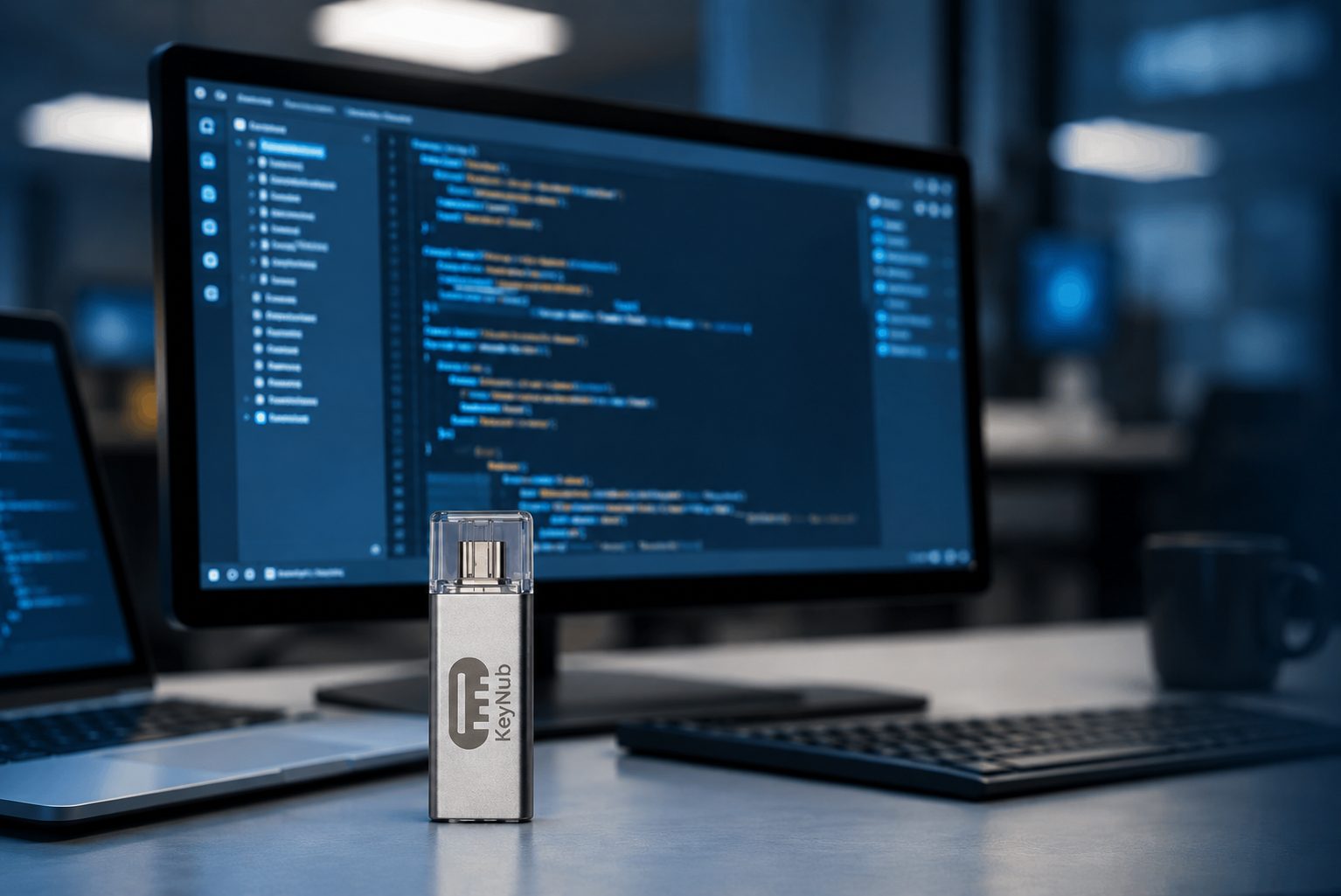
A clean SDK, real documentation and prebuilt native libraries let you integrate the license dongle in hours rather than weeks. Bindings for 43 languages — C and C++, .NET, Python, LabVIEW and more — each with a runnable sample in the open SDK repository.
For Software Vendors
Protect your software investment
You might build CAD, CAM or CNC software, PLC programming and industrial automation tools, medical or GIS applications, scientific and engineering software, audio production or broadcast tools, measurement systems or flight simulation. Whatever the field, your intellectual property deserves better protection than a serial number in a text file. The industry overview shows how KeyNub fits each of these, plus automotive diagnostics, machine vision and video surveillance.
Prebuilt native libraries cover Windows (x64, 32-bit and ARM64), Linux (x86_64 and ARM64) and macOS as a single universal binary for Apple Silicon and Intel. Licenses live on the key itself, so they work offline and move with the dongle from one machine to the next.
Already using a dongle? See how KeyNub compares with CodeMeter and Sentinel HL, fact by fact, with a concept map for switching.
For OEM Partners
Your own license dongle — under your own brand
Want to offer your customers a hardware license dongle of your own?
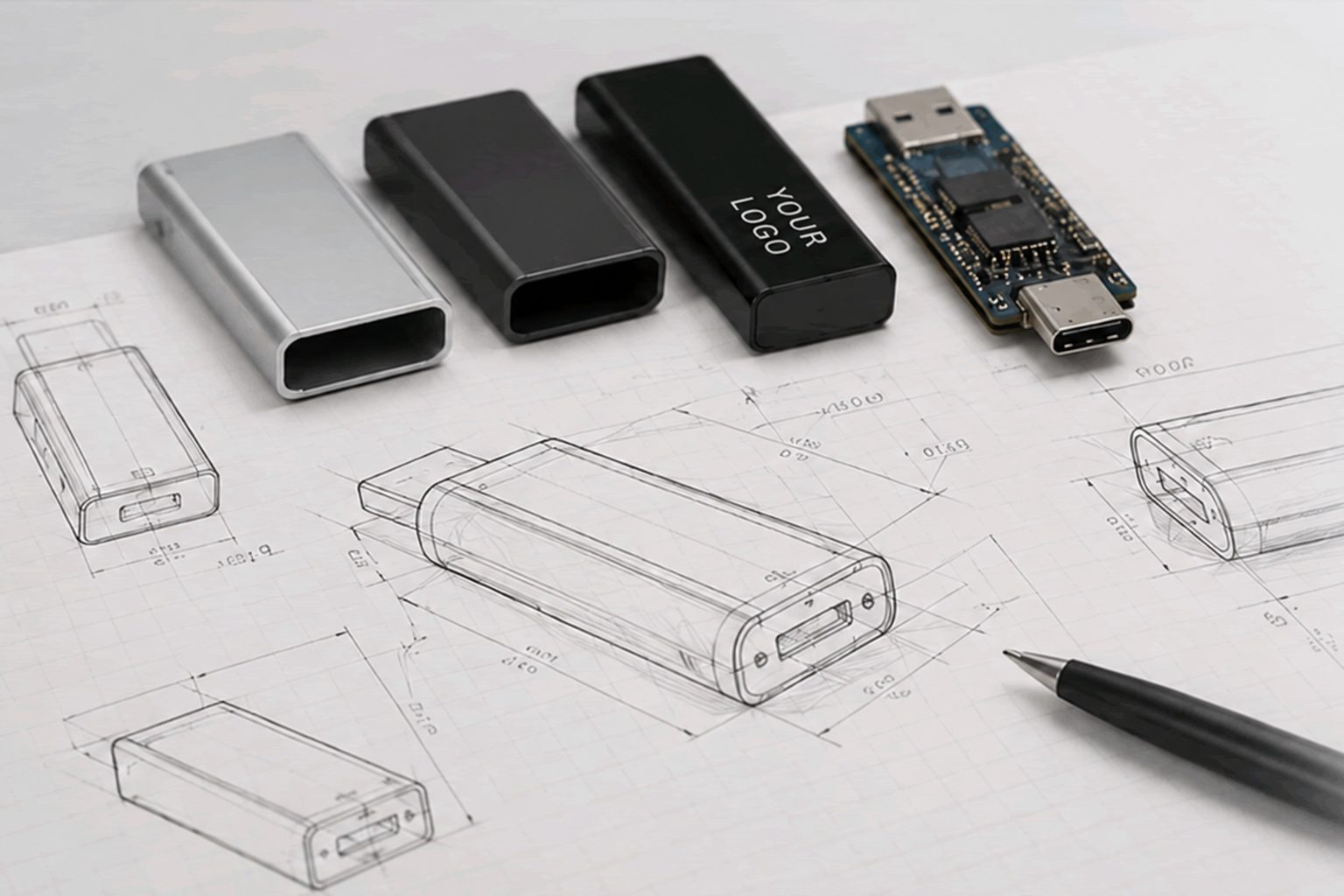
KeyNub is available as an OEM platform, including:
- Custom enclosure design
- Your own logo
- Your own USB VID/PID
- Custom firmware
- Dedicated security features
- Volume manufacturing and logistics
You get a professional licensing solution without developing hardware yourself.
Built for Your Industry
Licensing fails differently on an offline shop floor, in a recording studio and on a clinical network — so we wrote up how KeyNub fits each industry where a license dongle earns its keep:
CAM & CNC · CAD & BIM Plugins · Industrial Automation · Machine Vision · Measurement & Test · Automotive Diagnostics · Medical Software · Scientific Software · GIS & Geospatial · Audio Plugins · Broadcast & Media · Video Surveillance · Simulation & Training
Designed for Modern Software Protection
Local verification. No license server. No phone-home.
Built by software engineers, for software companies.
Technology at a Glance
Native USB-C
Easy SDK Integration

Windows
Hardware Security

OEM Branding

Linux
Crypto Auth
Secure MCU

macOS
Questions We Get Asked
Do I Need to Install a Driver?
No. The dongle is a vendor-defined USB HID device, so Windows, Linux and macOS talk to it with their built-in drivers: no INF file, no kernel module, no vendor service. On Linux, a one-line udev rule makes the device accessible without root.
Does Licensing Work Offline?
Yes. Verification is a local exchange between your application and the dongle: a certificate chain to KeyNub’s root plus a live challenge-response. There is no activation server, no license server and no account, so licensing works on air-gapped machines and on the factory floor, and nothing depends on a server of ours.
Can a Dongle Be Copied or Emulated?
The key pair that identifies a dongle is generated inside its secure element and cannot be read out, so there is nothing to copy onto another device. Every check is a live challenge-response against that key, so a recording of an earlier check does not replay, and the SDK verifies the dongle’s certificate chain to KeyNub’s root before it trusts the answer.
Can a Customer Patch My Application?
A dongle cannot stop somebody who has your executable from editing it. What the SDK is designed for is to make that pointless: you route data your program needs through the dongle’s app-data encryption, so removing the check removes the data. The integration guide walks through the pattern.
Which Languages and Platforms Are Supported?
Bindings and runnable samples for 43 languages, from C, C++, .NET, Python and Java to LabVIEW, MATLAB, Delphi, Rust, Go and Elixir, with packages on NuGet, PyPI, npm, Maven Central, crates.io and many more registries. The native library runs on Windows, Linux and macOS, on x64 and ARM64.
How Much License Data Fits on a Dongle?
1 MB of encrypted storage, organised as named records that your issuing tooling writes and your application reads. Records can be read only through an authenticated session between your application and the dongle.
Who Can Write Licenses to a Dongle?
Only the holder of the dongle’s write key. Each dongle arrives with a factory write key that you replace with your own once, when it arrives; from then on only your key can write, erase or increment. That key belongs in your issuing tooling, never in the application your customers run.
What Happens When a Customer Loses a Dongle?
The license lives on the dongle, so the replacement is a new dongle written with the same records from your issuing tooling. Nothing has to be deactivated anywhere, because nothing was registered anywhere.
Is the SDK Open Source?
The bindings, the samples and the C ABI header are Apache-2.0 on GitHub. The prebuilt native library ships under separate binary license terms. The security architecture is described on this site.
Where Is KeyNub Developed?
In Munich, Germany, by AB-Tools GmbH, which also provides the support. Hardware, firmware, secure-element provisioning and the SDK are developed in house.
How Does KeyNub Compare with CodeMeter or Sentinel HL?
Fact by fact, on two pages sourced from the vendors’ own documentation: KeyNub compared with CodeMeter and KeyNub compared with Sentinel HL. Both cover form factors, drivers and runtime, the security element, storage, SDK licence, languages and server components, and map the concepts for a migration.

Also from KeyNub: The Hardware Security Module
When the keys are the product, not the licence
The license dongle proves a licence is present. The KeyNub HSM is the other half of the family: a USB-C hardware security module for the keys your business runs on. RSA to 4096 and ECC to P-521, generated inside a Common Criteria EAL6+ certified smart card and never extractable — for certificate authorities, code signing, TLS server keys and document signing.
Same USB-C hardware family, same driverless approach: it presents the standard smart-card reader class, so Windows, Linux and macOS each bind their own built-in driver and your existing PKCS#11 tooling drives it with nothing to install.
Contact Us
Ready to move your licensing onto hardware?
Whether you need ten dongles or fifty thousand, KeyNub scales from a one-person software company to an enterprise rollout.
Let’s talk about your licensing strategy.
Why hardware licensing?
✔ Stops casual copying and license sharing
✔ Works fully offline — no internet, no cloud, no accounts
✔ Ideal for industrial and government environments
✔ Licenses move with the dongle, from one machine to the next
✔ Simple replacement if a unit fails
✔ No recurring license fees
Why KeyNub?
✔ Native USB-C, no adapter needed
✔ Compact premium enclosure
✔ Secure element, with keys generated on the device
✔ SDK source published, so you can read it before you buy
✔ Long-term product availability
✔ Developed and supported in Germany
✔ Cost-effective, even in small quantities
